EN
EN
 it
it  fr
fr  de
de  ru
ru  pt
pt  es
es
Get in Touch with WeiYuanDa Now!


Broadcast transmitters—whether FM radio, VHF/UHF television, or digital terrestrial broadcasting—depend on RF power amplifiers that deliver consistent output power across fixed frequency bands. At the heart of every amplifier stage lies a printed circuit board that must carry high-power RF signals with minimal insertion loss, stable impedance, and reliable thermal performance. Standard FR-4 boards are rarely sufficient for these applications: signal loss rises sharply at VHF and UHF frequencies, thermal conductivity is limited, and material properties drift under sustained high-power operation.
High frequency PCBs manufactured with specialized laminates such as Rogers, Taconic, and Arlon address these challenges directly. They provide low dielectric loss, stable dielectric constants across temperature and frequency ranges, and enhanced thermal characteristics that help keep power amplifier stages within safe operating limits. For broadcast equipment designers and system integrators, selecting the right high-frequency PCB manufacturer is as critical as selecting the right RF transistors.
WeiYuanDa Industrial Limited is a China-based high-frequency PCB manufacturer with over 20 years of experience producing boards for RF power amplifier, broadcast, and telecommunications applications. This article examines the key technical requirements of high-frequency PCBs in broadcast transmitter systems and explains how WeiYuanDa’s manufacturing capabilities support reliable, cost-effective amplifier designs.
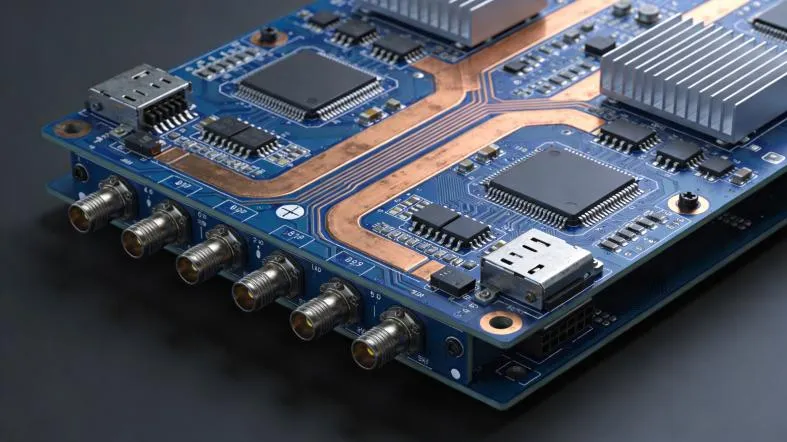
Broadcast transmission systems operate across a wide spectrum of frequencies. FM radio typically uses 88–108 MHz, VHF television covers channels 2–13 (54–216 MHz), and UHF broadcasting extends up to 890 MHz in many regions. Digital terrestrial television (DTT) systems such as DVB-T/T2, ATSC, and ISDB-T also operate within these VHF/UHF bands but demand even stricter linearity and signal integrity requirements due to complex modulation schemes like OFDM.
At these frequencies, the PCB substrate directly influences three performance parameters that determine broadcast quality and reliability:
1. Insertion Loss and Power Efficiency
Every decibel lost in the PCB substrate is a decibel that the power amplifier must compensate for by drawing more current. Over months and years of continuous 24/7 operation, accumulated substrate loss translates into significant electricity costs and additional thermal load. Low-loss laminates such as Rogers RO4350B or Taconic TLX reduce insertion loss substantially compared to standard FR-4, improving overall transmitter efficiency and reducing the load on cooling systems.
2. Impedance Consistency
Power amplifiers depend on precisely matched input and output impedance to maximize power transfer and minimize reflected power. Variations in dielectric constant (Dk) across the PCB—whether from material inhomogeneity, manufacturing tolerances, or temperature drift—cause impedance shifts that degrade power output, efficiency, and linearity. High-frequency laminates offer tightly controlled Dk values (typically ±2% or better) and excellent thermal stability, ensuring that the designed 50 Ω impedance remains consistent across production batches and operating temperatures.
3. Thermal Reliability Under Continuous Operation
Broadcast transmitters are expected to run continuously for years with minimal downtime. The RF power stages generate substantial heat, and the PCB must withstand prolonged exposure to elevated temperatures without delamination, copper peel-off, or electrical degradation. Materials with high glass transition temperatures (Tg) and robust peel strength, such as Arlon 85N with a Tg of 250°C, provide the thermal resilience required for high-power broadcast applications.
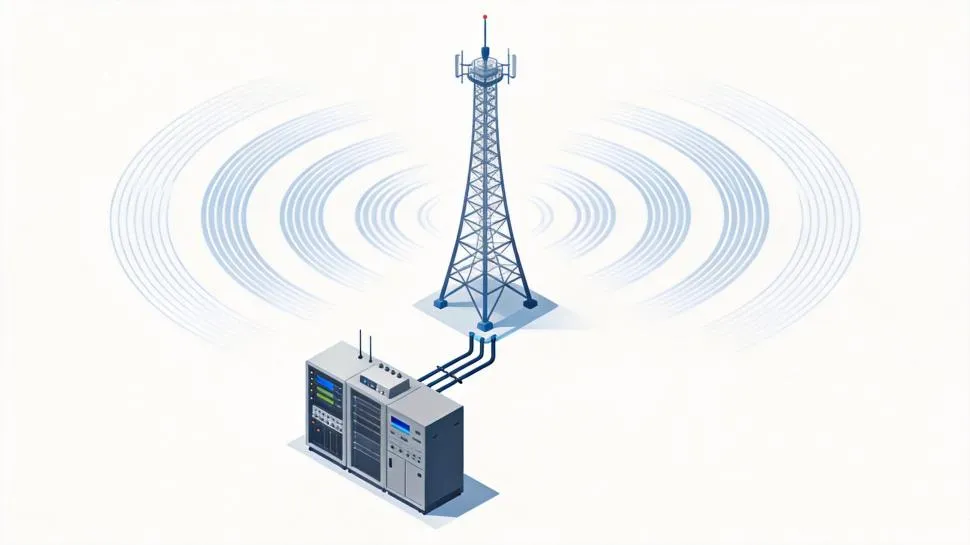
Designing PCBs for broadcast RF power amplifiers involves a set of challenges not typically encountered in low-power signal-level circuits. Power handling, thermal management, and long-term reliability become the dominant design drivers.
1. Copper Weight and Current Carrying Capacity
Higher output power requires thicker copper traces to handle the increased RF current without excessive heating or conductor loss. WeiYuanDa supplies high-frequency PCBs with outer and inner copper weights of 1 oz for standard designs and up to 2 oz for advanced HDI high-frequency configurations. For even higher current requirements, WeiYuanDa can combine heavy-copper PCB technology with high-frequency materials, delivering boards with copper weights of 3 oz, 4 oz, or more on specific layers.
2. Thermal Management and Heat Dissipation
RF power amplifiers generate concentrated heat at the transistor mounting points. If this heat is not efficiently spread and removed, junction temperatures rise, performance degrades, and component life shortens. Several PCB-level design strategies help manage thermal load:
Thicker copper planes on signal and ground layers improve lateral heat spreading from hot components.
Thermal vias beneath power transistors conduct heat from the top layer to inner ground planes and bottom-side heat sinks.
High-thermal-conductivity substrates such as Arlon 85N (0.20 W/m·K) transfer heat more effectively than standard FR-4 (approximately 0.03 W/m·K).
For extreme power levels, hybrid constructions combining high-frequency laminates with metal-core or heavy-copper layers can be engineered.
3. Controlled Impedance and Signal Integrity
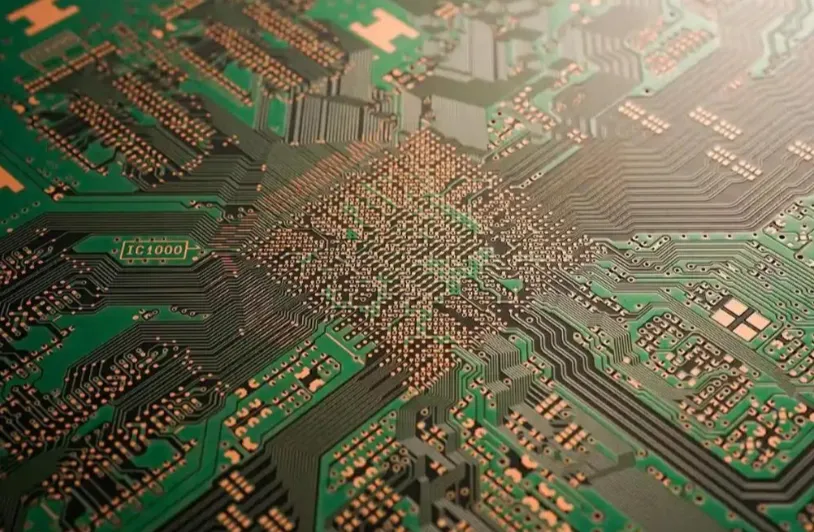
Power amplifier performance depends on accurate impedance control throughout the signal path, from the input connector through matching networks to the output filter and antenna feed. WeiYuanDa implements controlled impedance manufacturing with tight tolerances, supporting microstrip and stripline configurations across all high-frequency material types. Minimum line widths and spacings of 3/3 mil (standard) or 2/2 mil (advanced HDI) enable dense RF routing without sacrificing impedance accuracy.
4. Via Design and Back Drilling
In multi-layer high-frequency boards, via stubs—unused portions of plated through-holes extending beyond the target layer—act as parasitic reactive elements that degrade signal integrity and introduce unwanted reflections at higher frequencies. Back drilling removes these stubs, preserving signal quality in multi-layer RF boards. WeiYuanDa offers controlled-depth drilling and back drilling capabilities as standard features for high-frequency PCB prototypes and production runs.
WeiYuanDa Industrial Limited, together with Dongguan MaoChang Printed Circuit Board Limited, has specialized in PCB manufacturing for over 20 years. The company’s high-frequency PCB production line is equipped to support broadcast and RF power amplifier projects ranging from quick-turn prototypes to high-volume serial production.
1. Engineering Support and Prototyping
WeiYuanDa’s in-house engineering team of over 24 engineers provides technical support and Gerber file review within 6 hours of receiving design files. For prototyping, the company offers rapid turnaround in as little as 1 day, with RFQ responses provided within 2 hours. This speed is particularly valuable for broadcast equipment developers who need to iterate quickly on amplifier matching networks, filter layouts, and thermal design optimizations.
Unlike many PCB suppliers that only fabricate to spec, WeiYuanDa takes an end-to-end approach: from layout review through impedance validation to final testing, engineering staff actively identify and resolve manufacturability issues before production begins. This reduces redesign cycles and ensures that the first prototypes perform as close to simulation as possible.
2. Quality Certifications and Testing
Quality assurance is critical for broadcast infrastructure equipment, which must operate reliably for extended periods. WeiYuanDa holds ISO 9001, ISO 14001, ISO 13485, IATF 16949, and UL certifications. The company is also a member of IPC, with CIS and CIRS certifications on staff. Each high-frequency board undergoes impedance testing, electrical continuity verification, and visual inspection before shipment.
Pure high-frequency laminate is expensive, and not every layer in a broadcast amplifier board carries RF signals. Many boards mix high-frequency signal layers with digital control layers, power distribution layers, and standard ground planes. Building all these layers from premium RF material would add unnecessary cost without providing measurable performance benefit.
WeiYuanDa’s hybrid stack-up approach addresses this by using high-performance materials such as PTFE or Rogers laminates only on the critical RF layers, while the remaining digital and power layers use standard FR-4. This construction delivers the required RF performance on signal-critical layers while substantially reducing overall board cost. For broadcast power amplifier designs, hybrid construction is often the most cost-effective way to meet both technical and budgetary requirements.
WeiYuanDa’s engineering team works with customers to optimize stack-up configurations based on specific frequency targets, power levels, and thermal constraints. The goal is to achieve the necessary performance without over-specifying materials—a balance that requires both material expertise and manufacturing experience.
Q: Can high-frequency PCBs handle the power levels required for broadcast transmitters?
A: Yes, provided the right materials and copper weights are selected. High-frequency laminates such as Rogers RO435B and Arlon 85N handle significant RF power levels when paired with appropriate copper thickness (typically 1–2 oz or higher), adequate thermal management, and proper impedance control. WeiYuanDa’s engineering team evaluates each power amplifier design to ensure the PCB construction supports the required power handling and thermal dissipation.
Q: What is the typical lead time for high-frequency PCB prototypes?
A: WeiYuanDa provides rapid prototyping service with turnaround as fast as 1 day for standard high-frequency board designs. More complex multi-layer configurations with advanced HDI features typically require slightly longer lead times. RFQ responses are provided within 2 hours, and engineering file review is completed within 6 hours.
Q: Are hybrid high-frequency + FR-4 boards reliable for long-term broadcast use?
A: Yes, hybrid constructions are well-established and widely used in broadcast, telecom, and RF power amplifier applications. The key is proper material selection, controlled lamination processes, and impedance validation. WeiYuanDa has extensive experience with hybrid stack-up designs combining FR-4 with Rogers, Taconic, and other high-frequency materials, and each board undergoes full electrical testing to verify performance before shipment.