EN
EN
 it
it  fr
fr  de
de  ru
ru  pt
pt  es
es
Get in Touch with WeiYuanDa Now!


If your design involves LEDs, power MOSFETs, DC-DC converters, or motor drivers, you already know heat is the enemy. Thermal stress causes premature aging, solder joint fatigue, color shift in LEDs, and field failures that cost far more than the PCB itself.
This guide covers everything you need to know about Aluminum PCB technology for high-heat applications:
1) How the stack-up works and why each layer matters.
2) What thermal conductivity really means in real projects.
3) Key specifications you must define before sending an RFQ.
4) How to evaluate manufacturers who claim they can handle your thermal requirements.
Whether you're designing LED lighting, automotive lighting modules, power supplies, telecom equipment, or AI server cooling systems, this article will give you the technical foundation to avoid thermal failures during prototyping and mass production.
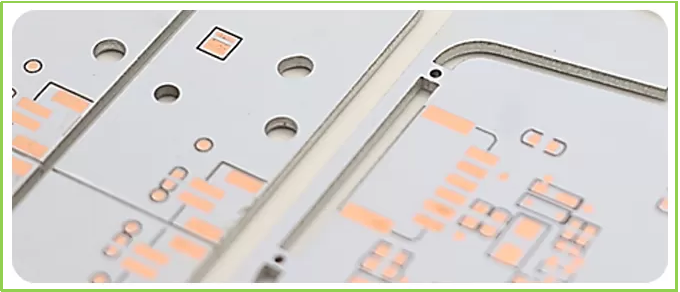
Thermal management is not optional anymore. LED lighting, automotive electronics, power modules, telecom infrastructure, and compact high-power devices all demand efficient heat dissipation in smaller form factors. Traditional FR-4 boards with standard copper pours cannot move heat away from components fast enough.
And thermal requirements are getting more demanding, not less. Higher power densities, tighter enclosures, and longer expected lifespans mean that, the PCB must do more than just connect components—it must actively manage heat.
Aluminum PCB technology solves this by creating a shorter thermal path from heat-generating components directly to the metal base. A standard aluminum board consists of:
Copper circuit layer: Carries current and spreads heat laterally
Thermal dielectric layer: Transfers heat vertically while maintaining electrical isolation
Aluminum base: Distributes heat into the enclosure or heat sink
The result? Junction temperatures drop 10-30°C compared to FR-4 solutions, LED lifespan extends significantly, and power components operate within safe limits. For products like LED modules, motor controllers, and switching power supplies, this isn't just a nice-to-have—it's the difference between a reliable product and one that fails in the field.
As power densities climb and enclosures shrink, Aluminum PCB technology has shifted from a premium option to a standard requirement for competitive designs.
Not all metal-core PCBs are the same. The distinction lies in three key design factors:
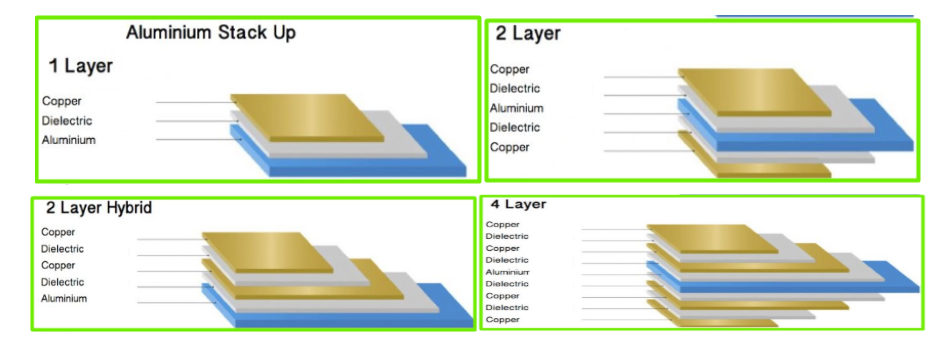
Stack-up Structure
Aluminum PCB uses a single-layer, double-layer, or multilayer copper circuit bonded to a metal base. The most common construction is single-layer aluminum PCB, which provides:
Direct heat path from components to aluminum base
Lower cost and simpler thermal modeling
Sufficient routing density for LED modules and power conversion
For higher routing density, double-layer and multilayer aluminum PCB structures are available, but they require more complex dielectric design and via isolation control.
Dielectric Layer Performance
The dielectric layer is the critical bottleneck in aluminum PCB design. It must provide:
Electrical isolation (typically 1-6 kV depending on application)
Thermal conductivity (1.0-8.0 W/m·K for most commercial grades)
Mechanical bonding between copper and aluminum
A thinner dielectric lowers thermal resistance, but the minimum thickness depends on working voltage, surge conditions, and manufacturing tolerance. Engineers should specify required dielectric strength and thermal target—not just ask for the thinnest possible layer.
Aluminum Base Selection
The aluminum base controls stiffness, flatness, weight, and heat spreading. Common choices include:
5052 alloy: Good formability, widely available
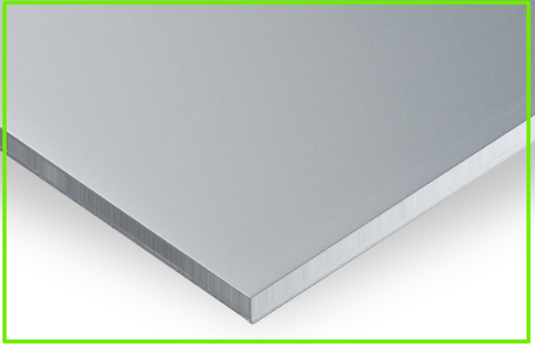
6061 alloy: Better machinability, smoother surface
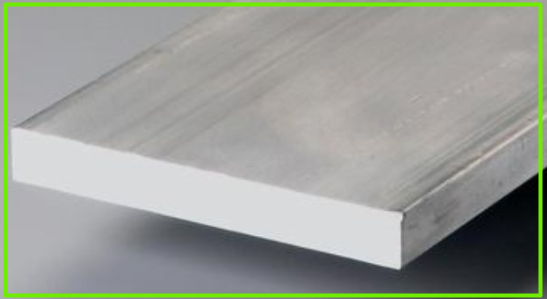
1100 alloy: Higher thermal conductivity, lower strength
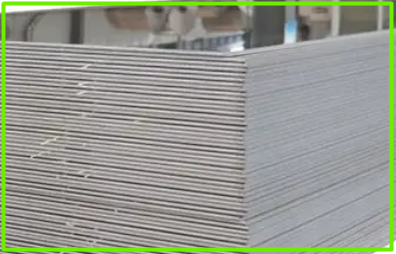
Base thickness typically ranges from 0.8mm to 3.0mm, chosen based on board dimensions, mounting requirements, and thermal interface area.
Before sending your design to fabrication, verify these critical parameters match your manufacturer's capabilities:
Parameter | Standard Aluminum PCB | High-Performance Aluminum PCB |
Layer Count | 1-2 layers | Up to 3-4 layers (with complex dielectric) |
Copper Weight | 1-2 oz/ft² | Up to 6 oz/ft² (for high-current applications) |
Thermal Conductivity (Dielectric) | 1.0-3.0 W/m·K | 3.0-8.0 W/m·K |
Dielectric Strength | 1.0-3.0 kV | 3.0-6.0 kV |
Aluminum Base Thickness | 0.8-2.0 mm | 1.0-3.0 mm |
Surface Finish Options | HASL, ENIG, OSP | HASL, ENIG, OSP, Immersion Tin |
Key considerations:
Thermal conductivity: Higher is not always better. Balance conductivity with dielectric strength and cost.
Copper weight: Match to current demand. Thicker copper improves heat spreading but reduces fine-feature capability.
Dielectric thickness: Thinner lowers thermal resistance, but must meet voltage isolation requirements.
Aluminum PCB is not necessary for every application. Low-power control boards or signal-only circuits work fine on FR-4. But for these use cases, aluminum is often the only viable option:
LED Lighting
Streetlights, automotive headlamps, industrial fixtures, and commercial luminaires all generate significant heat at the LED junction. Aluminum PCB moves heat away from chips, supporting stable brightness, better color consistency, and longer service life. Typical thermal conductivity requirement: 1.0-3.0 W/m·K.
Automotive Electronics
Lighting modules, motor control circuits, battery management systems, and ADAS subsystems operate in harsh environments with temperature cycling and vibration. Aluminum PCB provides thermal stability and mechanical robustness. Typical requirement: AEC-Q100 or IATF 16949 certified manufacturing.
Telecom and AI Server Infrastructure
5G base stations, routers, and AI server cooling systems require reliable thermal management in compact enclosures. Aluminum PCB helps maintain component temperature within safe limits during continuous operation. Typical requirement: High thermal conductivity (3.0+ W/m·K) with tight thickness tolerance.
At WEIYUANDA PCB, we combine over 20 years of metal-core expertise with rigorous quality control. Our advantage lies in precision engineering tailored specifically for thermal management applications.
Quality is our core. We utilize advanced equipment including AOI, microsection analysis, and Thermal Shock Testing to guarantee the accuracy and dielectric strength of every board. This ensures consistent performance even in high-stress environments.
We are certified with ISO 9001, ISO 14001, ISO 13485, and IATF 16949, alongside UL certification for both US & Canada. From fast prototyping to stable mass production, we serve as a trusted partner for LED lighting, automotive electronics, and power systems—delivering performance, precision, and long-term value.
Aluminum PCB technology enables reliable thermal management for high-heat electronics. Understanding stack-up design, dielectric performance, copper weight selection, and manufacturer capability will help you avoid thermal failures and bring your product to market faster.
When selecting an Aluminum PCB manufacturer, with WYD prioritize thermal knowledge, material selection capability, and engineering response over price alone. The right partner will save your time, reduce re-spins, and ensure your boards meet the thermal requirements of your application.
What is the standard aluminum PCB stack-up?
The most common structure is copper circuit layer, thermal dielectric layer, and aluminum base, with solder mask and legend on the circuit side. Single-layer construction is the simplest and most cost-effective for LED and power applications.
Does thicker copper always improve an aluminum PCB?
No. Thicker copper improves current capacity and lateral heat spreading, but it may increase cost and reduce fine-feature etching capability. Copper weight should be matched to current demand, routing density, and thermal requirements.
What files should I send for aluminum PCB quotation?
Send Gerber or ODB++ files, fabrication drawing, stack-up requirements (copper weight, dielectric material and thickness, aluminum thickness and alloy), working voltage, thermal requirements, surface finish, quantity, and delivery expectations.
About the Author: This article was prepared by the technical team at WEIYUANDA PCB, a leading Aluminum PCB manufacturer in China with 20+ years of experience serving global OEMs. For technical questions or quotes, visit wyd-pcb.com or request an instant quote.