EN
EN
 it
it  fr
fr  de
de  ru
ru  pt
pt  es
es
Get in Touch with WeiYuanDa Now!


Quick Answer: CEM-3 is a composite epoxy laminate made with woven glass fabric and glass mat reinforcement. Standard CEM-3 is selected mainly for cost, processability, and suitable electrical performance, while high thermal conductivity CEM-3 refers to specific enhanced material grades and should never be assumed from the CEM-3 designation alone. |
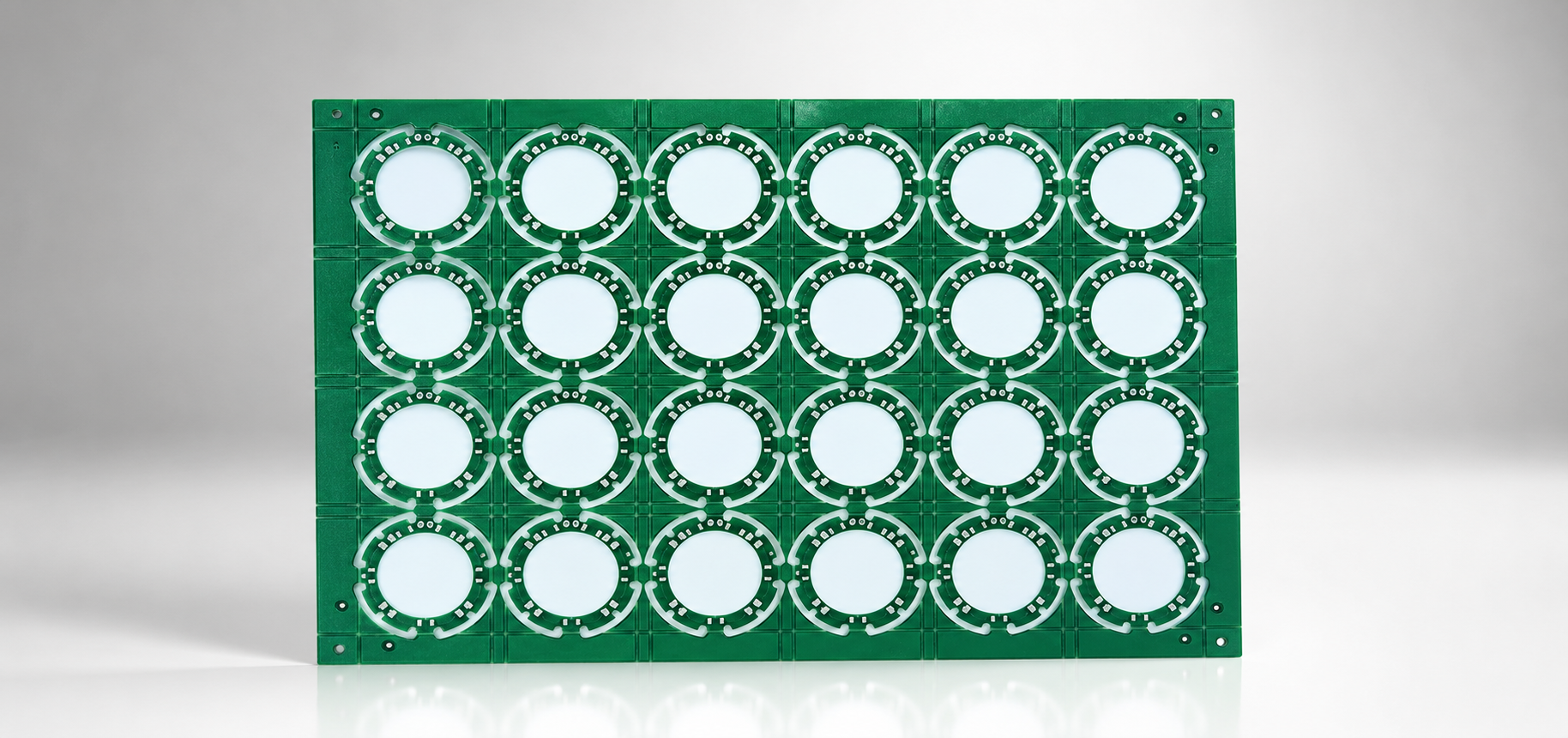
CEM-3 is widely used in single- and double-sided boards for appliances, lighting, power supplies, controls, displays, and other cost-sensitive electronics. It can process similarly to FR-4 in many operations and may offer easier punching or lower drill wear depending on the grade.
However, buyers sometimes treat all CEM-3 materials as thermally conductive. This guide explains the material structure, how enhanced grades differ from conventional CEM-3, and when FR-4 or an aluminum PCB may be the better choice.
CEM-3 PCB material is a flame-retardant composite epoxy laminate that combines glass fabric and glass mat reinforcement under copper foil.
The construction is different from conventional FR-4 woven-glass laminate, but many CEM-3 grades are designed for familiar PCB processes. Material suppliers commonly position CEM-3 for single- and double-sided boards where cost, electrical performance, punching or drilling behavior, and production efficiency are important.
Properties vary by manufacturer and grade. Thickness range, copper foil, glass transition temperature, decomposition temperature, CTI, dielectric performance, flammability, thermal conductivity, UV blocking, halogen status, and lead-free compatibility must be checked on the current datasheet.
High thermal conductivity CEM-3 is a specialized grade formulated to transfer heat better than a conventional CEM-3 laminate, but the actual value and test method are material-specific.
The label should not be applied to every CEM-3 board. For example, major laminate suppliers list both conventional and thermal-conductive CEM-3 product families. Procurement should therefore specify the exact brand and grade or define the required thermal property and acceptance method.
Thermal conductivity is only one part of board performance. Copper area, board thickness, component contact, solder pads, airflow, enclosure design, mounting, and heat-sink interface still determine the final temperature rise.
The correct substrate depends on routing density, heat flux, electrical isolation, mechanical requirements, manufacturing process, volume, and target cost.
Material | Typical Strengths | Typical Limitations | Best-Fit Applications |
Conventional CEM-3 | Cost efficiency, good processability, suitable electrical performance for many single/double-sided boards | Properties vary by grade; not automatically high thermal conductivity; generally less common for complex multilayers | Appliances, controls, displays, simple power and lighting boards |
Thermal conductive CEM-3 | Improved heat transfer while retaining composite-laminate processing characteristics | Must use a verified grade; may not match metal-core heat spreading at high heat flux | LED drivers, power controls and moderate thermal-load designs |
FR-4 | Broad availability, strong design ecosystem, multilayer capability, wide material range | Standard grades have limited thermal conductivity compared with metal-core constructions | General electronics, control, communication and multilayer designs |
Aluminum PCB | Direct metal-base heat spreading, mechanical stiffness, effective for concentrated heat | Special stack-up, machining and isolation design; routing density may be limited in simple structures | High-brightness LEDs, power modules, automotive lighting and high heat-flux assemblies |
CEM-3 is a practical choice when the circuit is relatively simple, volume is meaningful, the assembly process benefits from punching or efficient drilling, and the required electrical and thermal performance is available in a qualified grade.
It is often considered for remote controls, household appliances, display boards, power-supply subcircuits, game equipment, lighting controls, small industrial controllers, and other single- or double-sided products.
WYD’s laminate and solder mask downloads page includes CEM-3 datasheets from material suppliers. The selected grade should then be matched to a single layer PCB construction, board thickness, copper, assembly process, and product reliability target.
Choose FR-4 when the design needs multilayer routing, broad high-Tg or high-reliability material options, controlled impedance, dense fine features, or an established qualification based on a specific FR-4 family.
Choose an aluminum PCB when heat flux is concentrated and the assembly needs a direct path from LEDs or power devices into a metal core and heat sink. The WYD lighting PCB solution demonstrates typical use of metal-core boards in lighting, while the energy power supply PCB solution covers power-conversion and high-current applications.
A thermal-conductive CEM-3 grade can occupy the middle ground in selected applications, but it should be validated against the complete thermal path and not selected from material name alone.
A procurement specification should identify the controlled material characteristics and allowed substitutions instead of using only the generic term CEM-3.
· Manufacturer and grade, or an approved-equivalent list with change notification.
· Applicable IPC laminate slash sheet and UL recognition or flammability requirement.
· Board thickness, thickness tolerance, copper foil and finished copper.
· Tg, Td, z-axis expansion or thermal-stress requirement where relevant.
· CTI, insulation resistance, dielectric strength and moisture performance.
· Thermal conductivity value, test method and acceptance tolerance for enhanced grades.
· Lead-free process compatibility, maximum reflow or soldering profile, and required cycles.
· Drilling or punching method, hole quality, PTH reliability, outline tolerance and panelization.
· Color, UV-blocking, AOI compatibility, halogen-free or RoHS requirements if applicable.
Validation should include material-document review, DFM, first-article inspection, assembly trials, electrical test, dimensional checks, and application-specific thermal or environmental testing.
For thermal-conductive grades, measure the assembled product under worst-case load and ambient conditions. Compare hot-spot temperature, temperature uniformity, component margin, solder-joint temperature, enclosure temperature, and cooling performance with the target design. If the result is marginal, compare dielectric grade, copper area, board thickness, component placement, airflow, and metal-core alternatives.
Before releasing volume production, send the exact material requirement and application conditions to the PCB manufacturer. WYD PCB can review CEM-3 data, fabrication files, panel design, and prototype quantity through its contact channel.
No. Conventional and enhanced thermal-conductive CEM-3 grades both exist. The exact supplier grade and datasheet value must be confirmed.
No. Both are epoxy-based copper-clad laminates, but their reinforcement construction and grade families differ. Performance must be compared by datasheet and application.
Yes. Many CEM-3 grades support single- and double-sided board processing, including plated-through-hole applications when the selected grade and process are qualified.
It can improve heat transfer in moderate thermal loads, but concentrated high-power LEDs or semiconductors may still benefit from a metal-core heat path. Prototype comparison is recommended.
Appliances, remote controls, displays, simple power boards, lighting controls, consumer electronics, game equipment, and industrial control subassemblies are common examples.
State the material brand and grade or controlled properties, thickness, copper, layer count, hole process, flammability, CTI, thermal requirement, soldering profile, quantity, and test expectations.